
How Profico helped Bòme Vino bring Croatia's rare grape varieties to a global audience
Development
Reading time
4
mins

About Bòme Vino
A wine project built around places most people have never heard of.
Bòme Vino travels across Croatia to find vineyards where growers still work with native grape varieties that rarely leave the country: Tribidrag, Debit, Lasina, Plavina, Babić.
Every wine they produce is hand-harvested, organically grown, and released in small batches. Each release is finite by design. When a vintage sells out, the next one will be shaped by a different season, a different set of conditions.
Bòme Vino calls this being small by design, and they treat it as a founding principle of their business.
The challenge
Getting wine enthusiasts to learn more about a grape variety they've never heard of.
Bòme Vino sells the wine directly to customers across Europe, without distribution or a middleman.
For that model to work, the website has to do the job that a sommelier does in a restaurant: take someone who arrived without context and give them enough of a story that they want to buy a bottle of something they've never tried.
The challenge is that native Croatian grape varieties don't have the cultural familiarity of a Pinot Noir or a Chardonnay.
A customer landing on the site for the first time may not know what Plavac Mali is, what part of Croatia it comes from, or why the grower behind this particular batch matters. If the website treats the product as a catalogue entry with a price tag, it loses that customer at the first scroll.
At the same time, the site is a functioning store. Bòme Vino releases limited batches with no restocks.
When inventory moves, it needs to be reflected accurately and immediately. The commerce layer has to be as reliable as the brand layer is distinctive.
Both requirements had to be met by the same website, and they couldn't compromise each other.
How Profico helped to turn Bòme's vision into a website that earns attention
A digital experience where the story and the store work as one.
Extending an existing brand identity into every surface of the screen
Bòme Vino's physical identity was already carrying real weight when Profico came in. The bottle labels feature original illustrations celebrating freedom and hedonism. The whole visual system stands at a deliberate distance from what the wine category typically looks like.
Profico's design work began with a careful study of what that identity had already established so it can be translated successfully in digital form.
An illustration that reads perfectly at 90 millimetres on a label requires a completely different compositional approach when it becomes the dominant visual on a full-width page.
Typography that holds on paper needs to be re-evaluated across device sizes.
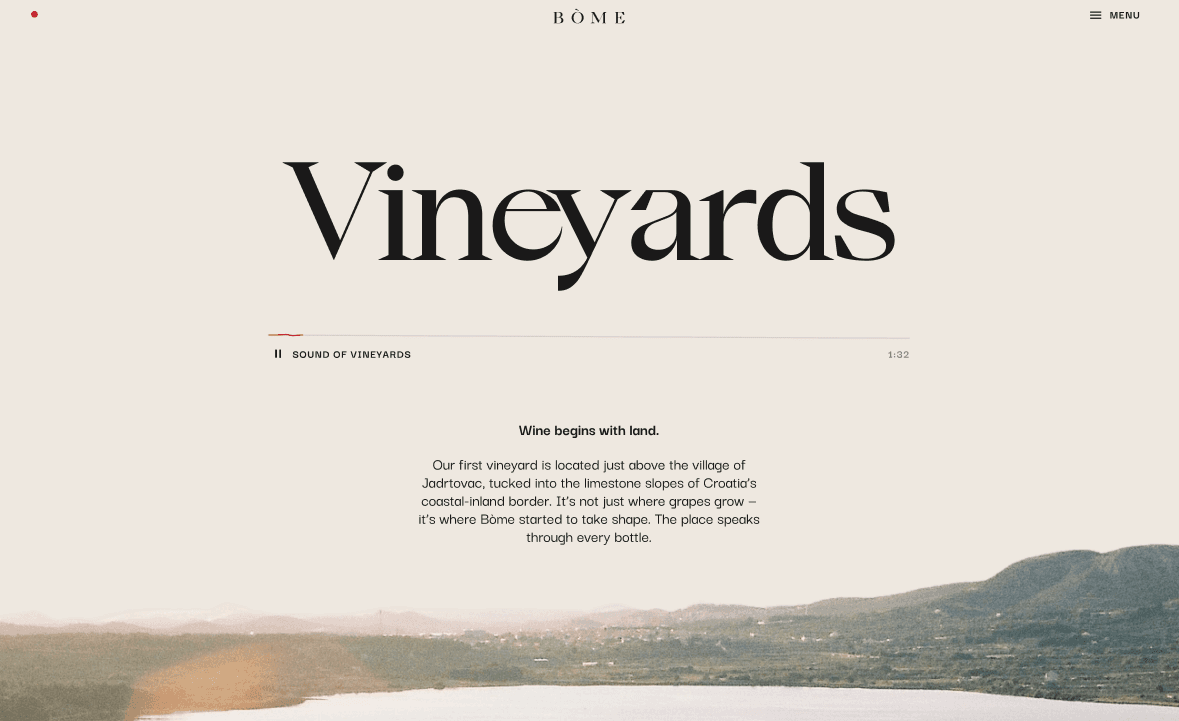
The result is a site where the label illustrations, the earthy photography of vineyards and hands and stone, and the typeface treatment all read as the same voice.
Nothing on screen looks like it was borrowed from a template.
Giving each wine the story it needs to earn the sale
The hardest sustained design tension throughout the project was between editorial depth and commerce function. Bòme Vino's wines need context to mean something to a new customer.
A product page that leads with a price and a tasting note is not enough for a bottle of Debit from a small grower in Dalmatia.
We structured each product page so the story leads into the purchase rather than sitting beside it.
A visitor learns about the vineyard region, the character of the grape variety, and the grower's approach before they reach the point of buying.
By the time they do, they're not deciding whether to take a chance on an unknown bottle. They're deciding whether to bring home something they've just been introduced to properly.
Running Shopify commerce through a Framer front end
For the front end, Profico built in Framer precisely because Bòme Vino's model never stops growing, and Framer makes it possible to add and scale new parts of the site far faster than traditional development.
The design system Bòme Vino required couldn't be built inside the constraints of a standard e-commerce theme. Those constraints would have flattened the brand into something generic.
The gap Framer creates is on the commerce side. Inventory management, payment processing, cart logic, and order handling across international markets are not problems Framer is built to solve. Shopify is.
Profico integrated Shopify's commerce infrastructure into the Framer front end through Shopify's Storefront API.
In practice, this means the two systems operate in parallel: Framer controls everything a visitor sees and experiences, and Shopify handles everything that happens when they decide to buy.
Product data flows from Shopify into Framer's CMS layer. Inventory state updates in real time across the site.
Cart and checkout run through Shopify's infrastructure, which carries the payment method coverage, security, and reliability customers expect from any serious online purchase.
This architecture, known as headless commerce, is more commonly associated with enterprise brands that have dedicated engineering teams to maintain it. For smaller premium brands, the conventional path is to accept a Shopify theme and the design constraints that come with it.
For Bòme Vino, that trade-off would have undone the purpose of the entire build. A customer who has just read about the grower behind their bottle and the specific Croatian valley where those vines grow should not then land in a checkout that looks like every other online store.
Giving the Bòme Vino team full control over releases
One practical consequence of the integration is that the Bòme Vino team now manages their product catalogue entirely from within Shopify.
When a new release is ready to go live, it enters the existing design system on the front end without requiring any development work.
When a batch sells out, the site reflects it immediately. The team operates their store the way they would with any Shopify setup, but their customers experience something that reads nothing like one.
What's Next
More releases, same infrastructure.
Bòme Vino's model is built around adding new wines as new partnerships with growers develop across Croatia.
Each release drops into the same Framer design system, with the full editorial treatment, the vineyard story, the photography, and the character of the grape variety given the space it needs.
The infrastructure Profico built is designed to hold that model as it grows, with no rebuilds and no development overhead each time a new vintage goes live.
Curious about how we approach other projects? Take a look at our other case studies.