
Vibe Coding for Enterprise: Balancing Rapid Prototyping and Scalable Development
Development
Reading time
9
mins

With all the hype around vibe-coding, one could argue that we are seeing the “fast-fashion moment” in product development.
And who wouldn’t be hyped by the idea where you can skip a six-month roadmap to have a fully functional feature or an app by tomorrow. It certainly is a powerful pitch for any business trying to get the grip in this exciting AI era.
If you are one of those who are tempted to jump in and vibe-code a new feature for your business or product, you might want to hear this first.
Recent data from McKinsey State of AI 2025 report suggests that while we’ve hit an era of "Mass Deployment," the honeymoon phase has hit a wall.
The study reveals that although 88% of organizations are now using AI, only a staggering 6% are actually capturing meaningful enterprise value from it.
For everyone else, that "saved time" is being eaten up by three risks that vibe coding often ignores: wrong answers, security holes, and the "Black Box" problem (where no one can explain why the AI did what it did).
What it means is, if you are looking to use vibe-coding for solutions on the enterprise level without clear strategy or even technical knowledge it may backfire easily.
That is why, in this post, we are going to look deeper at vibe-coding to get a clear overview of its possibilities, why it might look like a miracle tool for business owners or project leads, but also why it could turn into a silent killer if you trust your entire business with it.
We will also share a look behind the curtain as our COO Miro Marasović shows how we used vibe coding for research purposes, which ended up as a functional 'CV Generator' tool.
But first, let’s start from the beginning.
What is vibe coding and how does it work?
Vibe coding is a term coined by Andrej Karpathy (the former AI lead at Tesla and OpenAI).
It describes a new AI powered approach in programming where developers use natural language to guide LLM’s and AI agents to write most of the code for the apps that they are trying to build or design.
It allows developers to save time rather than writing code one line at a time.
At its core, the vibe coding process looks like this. You open an AI builder platform like Claude Code, n0, Supabase or Lovable, and you describe your goal using plain text or voice.
If you simply tell AI: “I need a dashboard that tracks my daily spending” - the prototype will appear almost immediately.
Of course, that is a simplified version of the process because you have to structure the prompt with many details to reach the goal.
The main point was to explain how vibe coding allows users to focus more on their innovative ideas rather than focusing on which technologies to use or understand programming languages. At least on the surface.
What are the benefits of vibe coding?
The good thing about Vibe-coding is that it removes the barrier between people with ideas and the ability to implement them.
With the new breakthroughs with AI technology, vibe-coding can help people with no coding experience to create a working prototype of their idea instantly.
When you look at it as a tactical tool rather than a final solution, the benefits are straightforward:
Fast-tracked prototyping: You can move from a concept to a functional URL in an afternoon. That is why it’s perfect for internal demos where you just need to see if a layout works.
Lower technical overhead: You don't need a full engineering team to test an initial idea. If you can describe the logic, the AI can show you a version of it.
Direct feedback loops: Changing a UI or a simple workflow is just a conversation. You can test variations without a heavy development cycle.
Market validation on a budget: It acts as a "smoke test." You can see if users find your feature interesting enough to use it before you invest in the robust code needed to support it.
Our vibe-coding experiment: Putting the benefits to the test with Supabase and n0
We love to talk about AI, but we also like to keep the receipts of everything we post.
Even before the vibe coding trend started picking up momentum, we saw the right opportunity to run experiments on some of our internal projects.
The idea behind our internal tool was simple - to create a central place where we keep track of all our employees and the specific projects they’ve worked on. It would serve as a database of our collective skills and experience that would help us streamline decisions once a new project hits our desk. - Miro Marasović, COO at Profico
Here is how it works. When a new client project comes in, the AI helps us look through that data to identify the best people for the roles based on their past work and specific skill sets.
It makes sure we’re utilizing everyone’s experience depending on the needs of the incoming project.
Having this information organized also helps the sales team when creating an offer for a new client.
Instead of having to hunt down information about the best people for the specific project, AI gives them all the necessary information to put an offer together quickly.
The development process
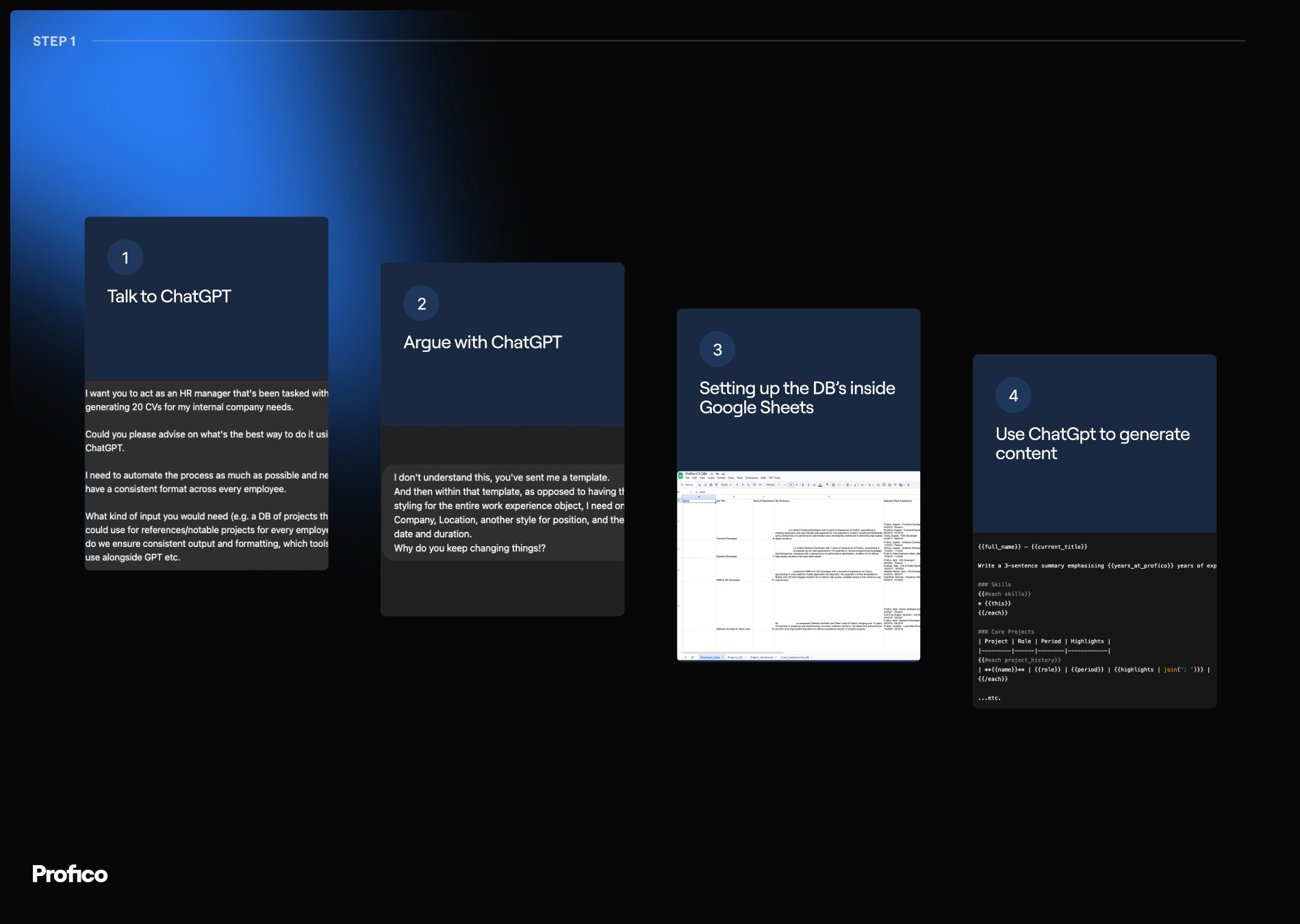
Step 1: Building the data foundation with LLM’s
We started by using ChatGPT to generate structured descriptions for every member of our team and every project we've worked on.
The goal was to create a shared repository that was detailed enough to be useful, but easy enough to update as the team grows.
For each team member, we created a profile covering their role, core skills, and the specific contributions they made on past projects.
For each project, we wrote descriptions covering the client context, the type of work involved, and the outcomes delivered.
The process looked like this:
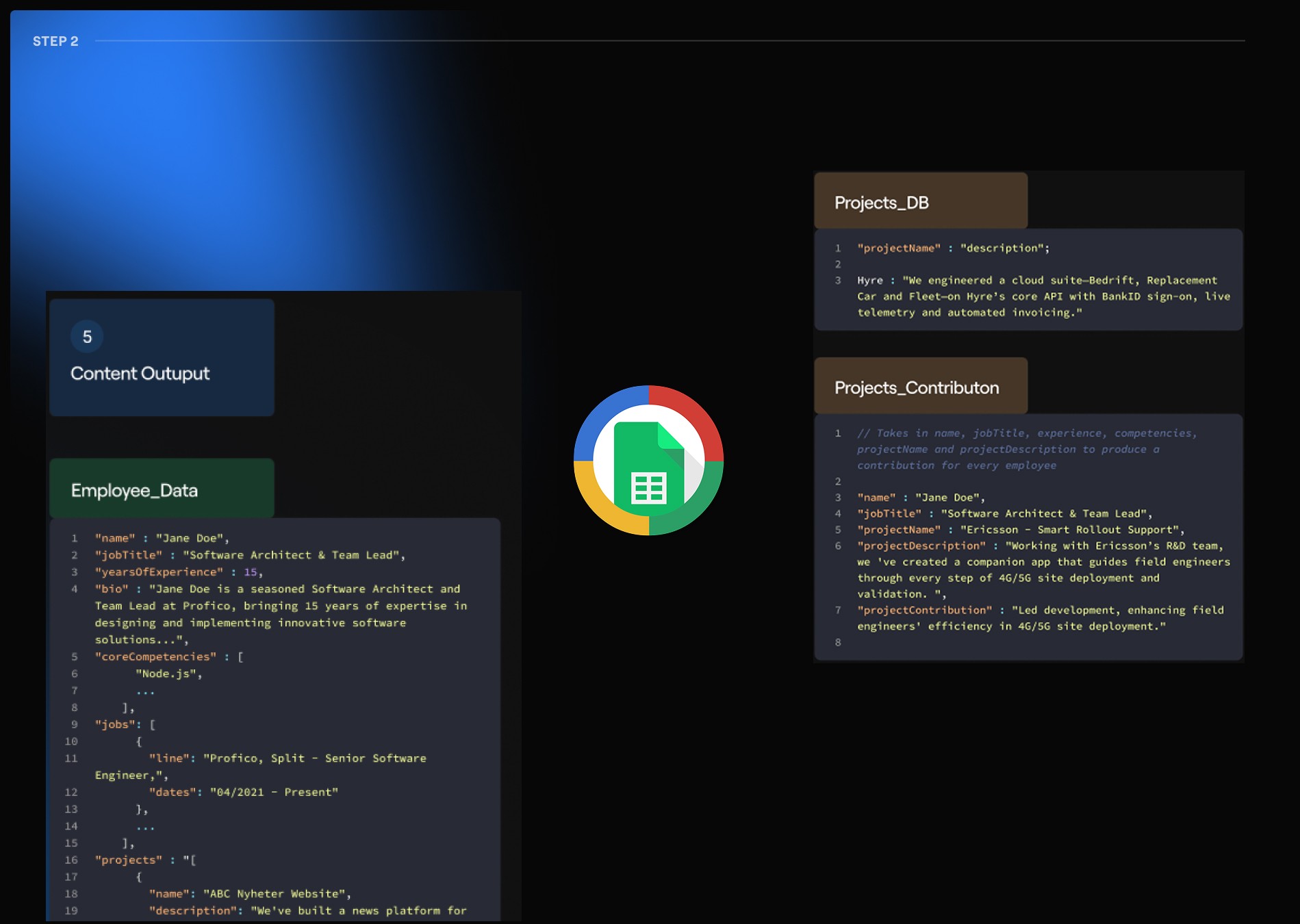
Step 2: Structuring the data in Google Sheets
Once we had the descriptions, we exported project data from Harvest — our time tracking tool — to identify who worked on what and in which capacity.
We used that data alongside the descriptions to build out individual contribution records for each team member across every project.
All of this was organized in Google Sheets, which served as our working database. It gave us a structured, editable source of truth that the AI could reference when making recommendations.
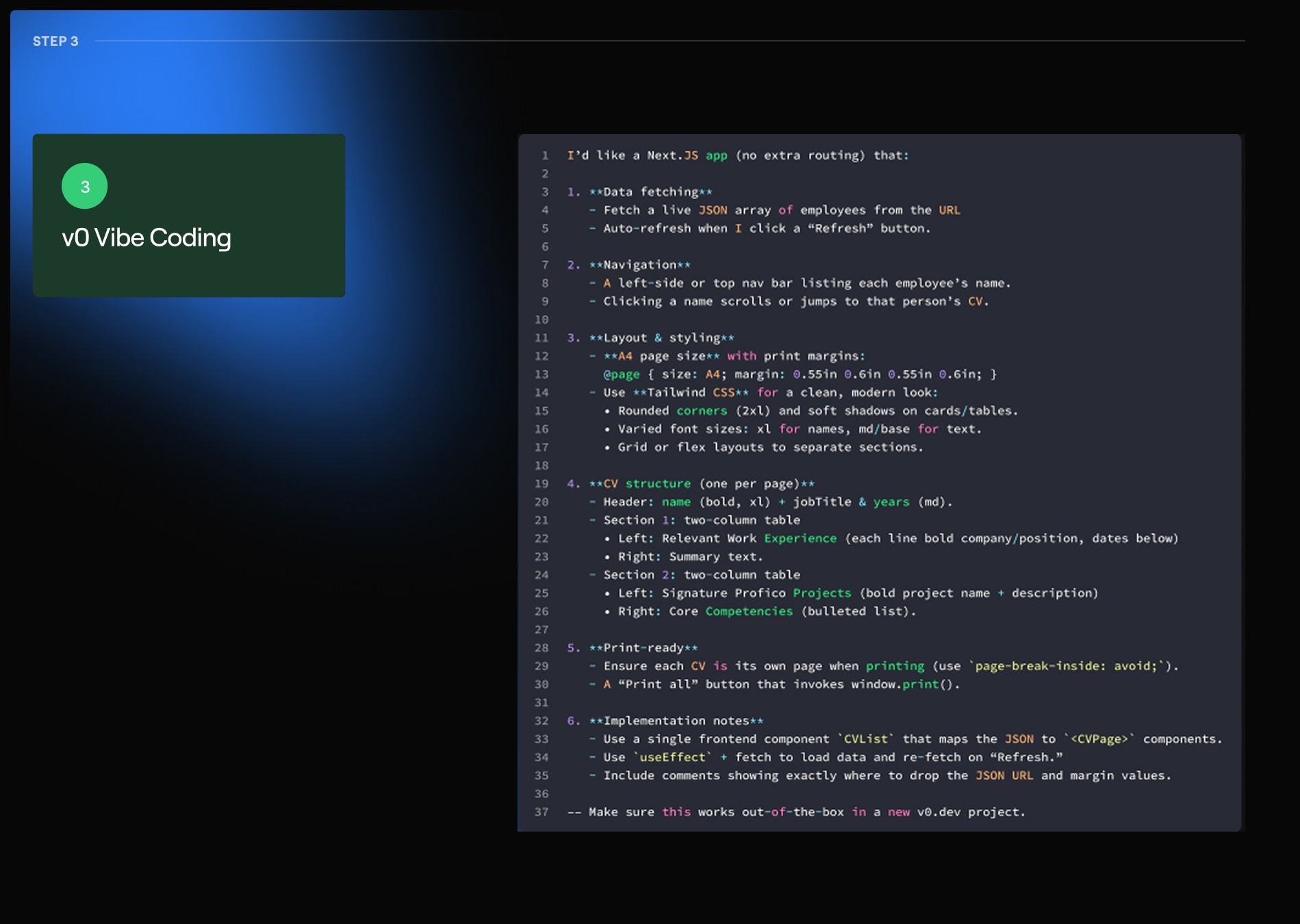
Step 3: Vibe-coding session
With the database in place, we connected it to our AI builder and defined the requirements: what inputs the tool needed to accept, what it should search for, and what format the output should take.
From there, the vibe coding process took over — generating the interface, the logic, and the initial version of the CV Generator with minimal manual development on our end.
What benefits we noticed: Beyond the speed of the build
After polishing our data and adding some vibe coding magic we had a "CV Generator" ready to use.
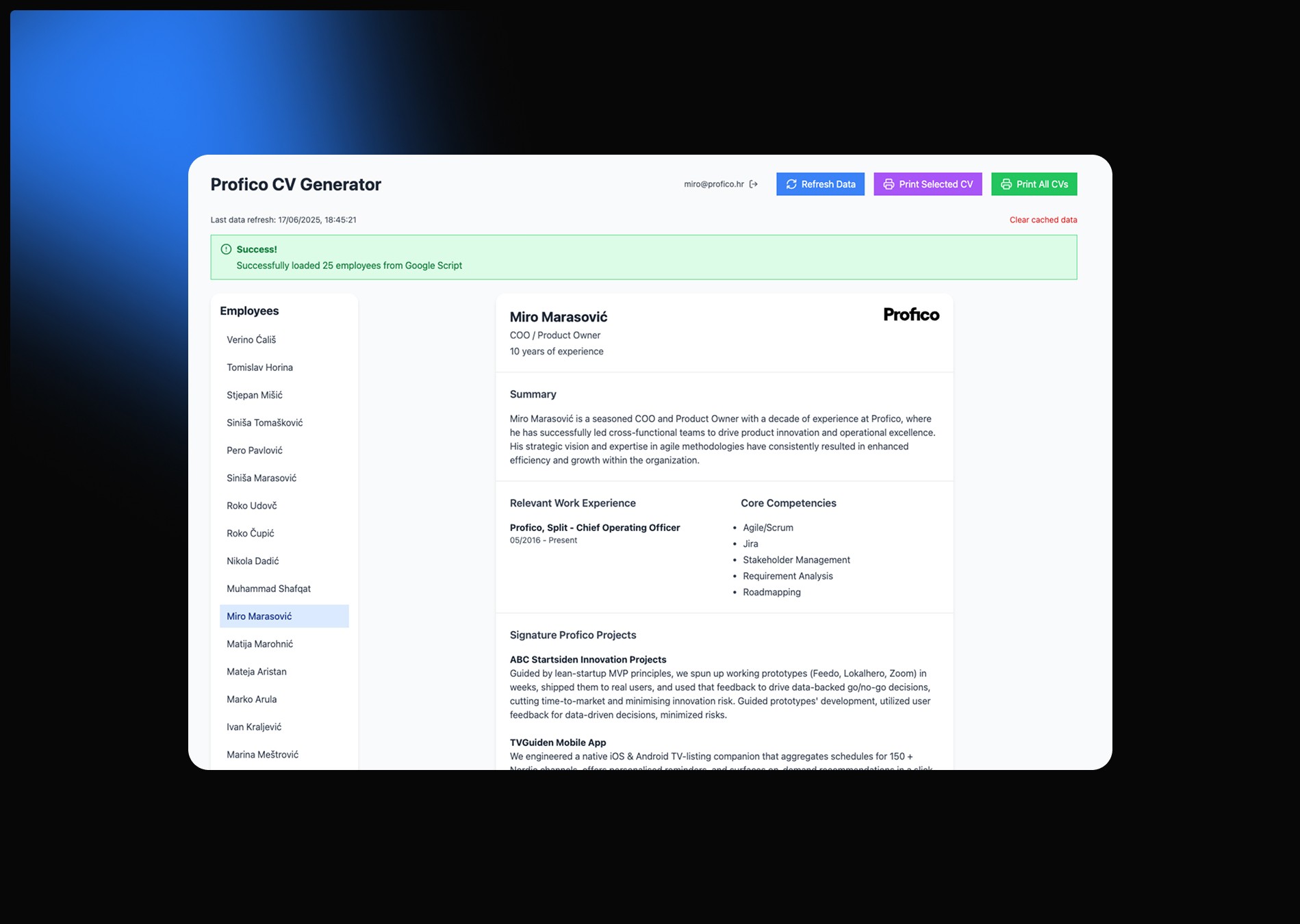
Here is the summary of what we found out during the vibe coding sessions.
Database setup and migrations: It set up the tables and handled the schema without any manual setup from us.
Full-stack functionality: We had working projects, tasks, and time entries on both the front and back end almost immediately.
Visual inspiration: We uploaded screenshots of our UI examples and the AI used them as a direct blueprint for the CV Generator.
Basic logic: Search, filtering, and pagination were functional right out of the box.
Live deployment.: It pushed everything to a live URL in one go.
What are the limitations of vibe coding?
Vibe-coding was proven beneficial, especially for product teams in terms of having a prototype ready within a day and showing it to clients so further steps can be discussed.
But you can’t treat vibe coding as a magic wand. You will need someone with technical experience and knowledge and here is why.
After we built the CV Generator, we started noticing where it falls short:
Technical complexity hits a ceiling fast Adding more complex features can quickly become a bottleneck. We had to fork our project every 50 versions just to keep the context from breaking the app.
Code quality requires human attention: Vibe coded apps still need code optimizations. We realised that when we spent too much time fixing tiny details and micro interactions. This showed us that vibe coding is still not on “that level” to create distributed applications because it requires structured level architecture.
Debugging is harder without coding skills: This was our biggest roadblock because AI-generated code lacks a consistent structure. If you lack coding skills this process would be harder because you'll have a hard time identifying and resolving any coding issues.
Maintenance and context AI has a short memory: It constantly lost the personal context of our project, making it hard to pick up where we last stopped. If you aren't manually keeping the logic updated, the whole application becomes an unoptimized mess that's impossible to scale.
State management breaks easily: The "vibe" doesn't really understand how to keep a session alive. Our app logged users out every time they hit refresh, and navigating between tabs broke the refresh states. It’s a constant battle to keep the user experience seamless.
Security is not built in: This is the part you can’t ignore. Since this code usually skips standard security checks and peer reviews, it’s easy to miss vulnerabilities. It works for a quick demo, but you’re taking a massive risk if you don't have a human eye on the final output.
If vibe coding has limitations can it be useful for business?
If you have searched for this topic on every corner of the internet you might've seen plenty of debates over this topic.
A majority of industry practitioners and daily practitioners agree on one thing - vibe coding is helpful in prototyping, discovery phases, as creative aid.
But, there is a small footnote. You need experienced people in your team who will treat the AI as an error prone junior who needs direction.
After a few initial tasks experienced engineers can spot their limitations, and they will pick the right moment to tell them to step aside and take over.
To sum it up you can rely on vibe coding at the beginning of any project, but you can never let it be the last step for anything you wish to create.
The more context and structure you give the model upfront, the less it fills in the blanks with things you didn't ask for.
That principle matters even more when you are using vibe coding for business purposes.
Why is it important to highlight that, especially if you are considering vibe coding for business purposes?
The ability to ship something today without spending time on documentation or roadmap is tempting to many small teams, or CFO’s who are looking for cost optimizations, especially in the times where digital products need to adapt quickly to market changes.
Before getting in that trap of excitement thinking how you will have a new feature built while your competition is still debating over how to implement it, business leaders should ask the right and hard questions.
Just like any technological novelty, vibe coding brings a lot of benefits, but in this early stage you must remember that everything new also comes with a set of challenges that must be explored before making your decision.
Should your business use vibe coding or professional development?
It depends on the context. If your main goal is to build something that a handful of people inside your company will use, and your priority is not polishing the solution or tool, then yes.
You can have more room to move fast and think about improvements as you go.
On the other hand, when you're building something that sits at the core of how your business operates, the entire development process needs to be held to a much higher standard, because more people, more processes, and more money depend on it working correctly every single time.
Enterprise systems don't just work for individual users in isolation. They have to work seamlessly in association with every other system in the business, used by multiple people simultaneously, across different devices, often with different permission levels depending on the role.
That's a fundamentally different problem to solve, and it requires a development process designed around that complexity from day one.
Code reviews, staging environments that mirror production conditions, CI/CD pipelines that let you roll back a deployment in minutes, these are the mechanisms that catch what a single developer working alone would never think to test for.
Think about what a banking platform actually looks like at the infrastructure level.
It's a network of services talking to each other in real time, many of them built years apart, connected to payment processors, regulatory reporting systems, fraud detection layers, and customer-facing interfaces all at once.
When you introduce new code into that environment, you're asking whether it behaves correctly when it interacts with every other piece of that system, under real transaction volumes, with real user data flowing through it.
The Knight Capital Group found this out in 2012 when a software deployment error triggered unintended trades and accumulated a $440 million loss in 45 minutes. The code did exactly what it was instructed to do. Nobody had fully mapped what those instructions would mean when the system went live.
In environments where your software connects directly to decisions that affect customer's money or health (healthcare industries), the process around the code matters as much as the code itself.
Professional development produces software with a test history, a paper trail, and a rollback strategy, and for enterprise systems, that is the baseline expectation.
Conclusion
At the beginning of this piece, we compared vibe coding to a fast-fashion moment in tech. And like fast fashion, the appeal is obvious.
You get something that looks good and doesn't take long to produce.
The question was never whether that has value. It clearly does. The question is what you do when the occasion demands something built to last.
Right now, the tools are moving faster than the guardrails around them, and the businesses that understand that aren't avoiding vibe coding. They're just honest about where it fits into their workflow.
They use it where speed matters more than permanence, and they bring in professional development where permanence isn't optional.
That instinct will only become more important as the technology matures, because the gap between what vibe coding can produce and what enterprise systems require will close gradually, not all at once.
Until it does, the businesses running ahead of that curve are the ones treating this moment not as a choice between two approaches, but as an opportunity to understand what each one was actually built for.