
How Agentic AI Can Improve Fraud Detection in Corporate Banking
Development
Reading time
5
mins


Over the next 10 to 12 months, 70% of CEOs in the banking sector plan to increase their AI budgets and allocate around 10-20% of their total budgets to new initiatives.
As latest trends suggest, a fair share of those budgets will be allocated to exploring agentic AI solutions for fraud detection purposes, as increasingly sophisticated fraud tactics create a need for more advanced detection detection capabilities.
This year the market for Agentic AI in fraud detection is valued at 11.53 billion, and it is estimated it will grow to 55.66 billion (48.2% increase).
Even with AML and KYC frameworks in place, it seems that current systems can’t keep up with the speed and sophistication of new fraudulent tactics.
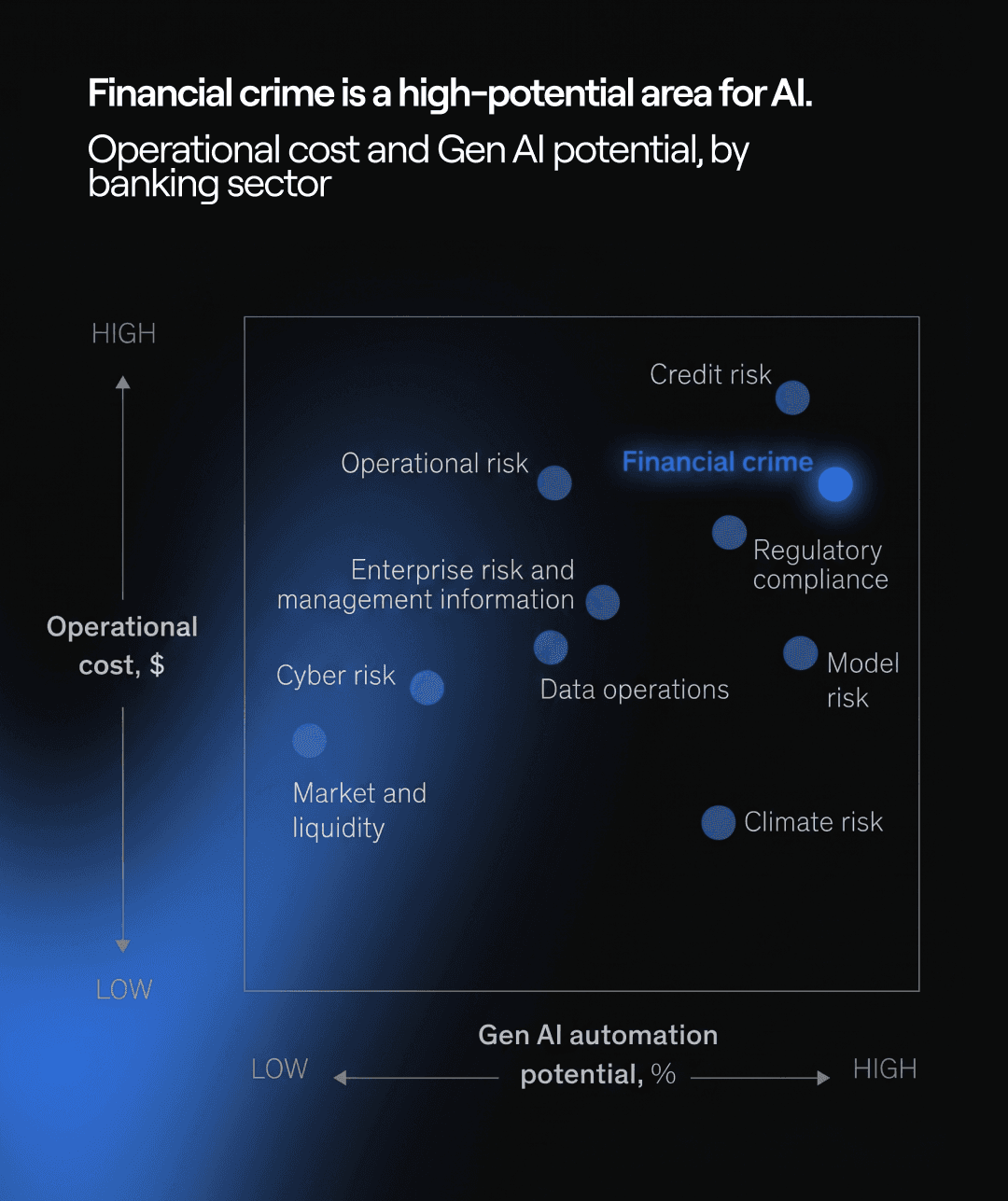
*Image source: McKinsey & Company: Operational cost and Gen AI potential, by banking sector
This is why the potential of Agentic AI is increasingly being explored as a way to address the inefficiencies of current systems and overcome their limitations in detecting and responding to emerging fraud patterns.
In this first article, we’ll explore the concept of agentic AI and why it can help banks keep up with increasingly evolving fraud tactics.
What is even agentic AI and how does it relate to corporate banking?
Agentic AI refers to systems that are designed to act autonomously as agents on behalf of their human users and other AI systems to make decisions or take actions to achieve specific goals.
If this definition sounds too abstract to you, we will try to explain its potential and implications in the banking sector by using a simple fraud detection example.
Let’s say your AML analyst got a notification for a flagged transaction in the dashboard.
If the bank’s system relies on basic automation or uses conventional AI (for example off-the shelf analytical and generative tools), the analyst would get a score and decide if the transaction requires further investigation.
Solutions like these are very powerful when it comes to speed up the daily processes but at the end of the day, they are static as they “wait” for humans for the data inputs or instructions.
Meanwhile, Agentic AI is a system that acts more proactively and independently, which means it can do a lot more than give scores.
So if we go back to the example, Agentic AI would have the ability to use banks’s data to cross-check the transaction location, check at the past behaviour, and even place a temporary freeze on the card.
With conventional AI solutions, AML analysts would have only AI scores, but with Agentic AI they would be looking at a fully prepared case.
If you are interested in use cases where Agentic Ai can be implemented in banks, you can check it out in our blog: 6 Realistic Cases for Implementing Agentic AI in Retail Banks
The next phase of handling tasks in AML/KYC context
When we talk about AI, we still tend to see it as a single technology, when in reality it covers a range of different concepts.
"Traditional AI" is mostly used for analytical tasks, while generative AI focuses on creating new content. Agentic AI takes this a step further by enabling AI to act on those capabilities.
Within the banking industry, analytical and generative AI solutions have made teams much faster in the investigation process, but they haven’t transformed the process itself or made it significantly more effective in terms of reducing fraudulent activity.
Agentic AI is considered as an evolution because it allows multiple AI agents to work together across the process.
Instead of just generating reports and results, an agentic system can handle tasks across multiple stages of a workflow and pass the output from one stage to the next without an analyst having to manually connect the results.
Analysts would still oversee the process and verify the work, but they would also spend much less time on the manual tasks involved.
Here is how it looks like in a real life example.
Lloyd Banking Group decided to implement agentic AI in within its fraud prevention operations, where multiple AI agents support bank operatives during live calls with customers who may be at risk of fraud or scams.
The main goal of the agentic system was to check the customer’s identity and the transaction in question.
To complete the task agents use that information to surface relevant risk signals and suggest what the person in the AML department should look at next.
It also creates an evidence trail from the conversation, so the colleague doesn't have to piece the case together manually while speaking to the customer.
According to internal sources, the bank expects the agentic system to reduce handling time by 35% by the end of the year.
What are the business benefits of Agentic AI in fraud prevention for banks?
1. Productivity Gains
The first business advantage for banks would be gaining the ability to increase the existing capacity of their AML and KYC departments without a proportional increase in headcount.
When an agentic system takes over the initial triage of flagged transactions, the entire department would be able to process a bigger volume of incoming cases with the same staff.
McKinsey shared an estimate that says that if one person within the department can supervise “a team” of 20 agents, the productivity could increase by 20 times.
2. Reduction in manual work hours
There are estimates that say banks currently dedicate up to 15% of their entire workforce specifically to manual KYC and AML tasks.
Instead of spending a lot of effort analysing different registries to gather data for a single client, a team of AI agents would be able to:
scan unstructured documents
pull out the necessary details
check the clients
and compare them against global sanctions lists on their own
Deloitte shared an insight showing that with agentic AI, an analyst wouldn't just be clearing single cases anymore. Instead, they could supervise an AI agent that continuously monitors up to 10,000 customers in the background.
3. Creation of an instant audit trail
Banks are required to conduct AML/KYC checks, but they also need to provide evidence to regulators for every compliance action, which means pulling information from different sources to build a single report.
The part where agentic AI would be able to speed up the work is creating an auditable log during the investigation of flagged transactions, with information on what data it accessed, the specific rules it applied, and direct citations for its decisions.
Recent data shows examples where institutions are seeing up to a 40 percent reduction in the time required to prepare documentation, and up to a 60 percent reduction in the time spent collecting evidence for audits.
4. Better customer experience
Compliance systems can sometimes create a lot of frustration for both banks and their clients because they rely on rigid rules that can generate so called “false positives” (flagging something suspicious when in fact is legitimate), which can lead to frozen accounts and repeated requests for identity documents that clients have already provided.
The solution for this might be an Agentic AI system that runs in the background and does what the industry calls “perpetual KYC” - meaning that AI agents would autonomously cross-reference multiple external data sources to figure out if the threat is real or just a mistake.
Gartner projects that by 2029, agentic AI will autonomously resolve 80 percent of common customer issues without a human analyst ever needing to intervene.
5. Improved consistency and quality output
Agentic AI could also make it easier for teams to document investigations consistently.
Sometimes, the problems can appear if team members interpret the same risk thresholds differently. One analyst may consider certain evidence sufficient to support a SAR while another may look for additional evidence or provide more detailed regulatory reasoning.
As a result, similar cases can produce SARs with different levels of information, which usually leads to more reviewing time.
With agentic systems in place teams would have the ability to take a more more consistent approach. The compliance team would set the rules and decision criteria, while agents would apply them as they work though each case, giving every analysts a more consistent starting point.
Recent data from an FSI Industry Analysis tracking agentic AI shows a 90% reduction in data errors when agents generate standardised narrative summaries and variance explanations.