
AI in Banking & Fintech: The 3-Step Framework to Find Use Cases That Actually Drive ROI
Development
Reading time
6
mins


Despite the broader financial sector spending $35 billion on AI in 2023, with that figure projected to reach $97 billion by 2030, the process of AI implementation continues to raise practical questions that organisations are still working through.
If you are a team operating within banking or B2B fintech ecosystems, identifying where AI fits means understanding whether it can handle your work more effectively than conventional automation, whether it can process and connect massive amounts of data in faster and precise ways, and whether the added complexity translates into measurable gains in efficiency and product capability.
That is what led us to write this article and share the low-risk and high-control framework we use to help enterprise fintech and banking organisations:
Spot high-impact AI features for their specific use cases
Establish technical requirements
Add well-defined AI features without changing the core product architecture
How to build and embed the custom AI layer directly into B2B finance products or internal workflows?
Before you can identify where AI can improve productivity across enterprise finance systems and workflows, you first need to understand what it takes to introduce custom AI capabilities without disrupting the systems they depend on, including the following challenges:
Working within the AI vendor infrastructure that financial institutions have already selected.
Adding the AI layer without touching the foundational mechanic of the system (or product).
Customising the AI experience for different clients without creating multiple versions of the main platform.
Making sure the new AI layer strictly obeys the data access limits already established in the core system.
Maintaining a clear audit trail to prove exactly where the AI pulled its information from the core system.
Our practical solution for these challenges relies on architectural isolation, which means that we introduce the integration layer that separates the external model from the organisation's core infrastructure, and that allows you to build custom capabilities while leaving the foundational systems entirely untouched.

How to find high-profile AI use cases? 3 steps for identifying and embedding realistic AI features
Enterprise financial systems and products naturally create many opportunities where AI can add value, and with the growing number of AI approaches available, decision makers inside these environments have a much harder task of identifying which opportunities deserve investment.
The problem is that each of those opportunities sits within a specific daily routine, depends on the data required to support that work, and often involves handling information from multiple sources, while also affecting the way clients or internal teams use the product, which means every decision needs to be evaluated within the context where it will operate.
This is why we created a three-step process that helps bring structure to that evaluation and identify the areas where AI has the strongest potential to create measurable value.
Here is how we structure each phase.
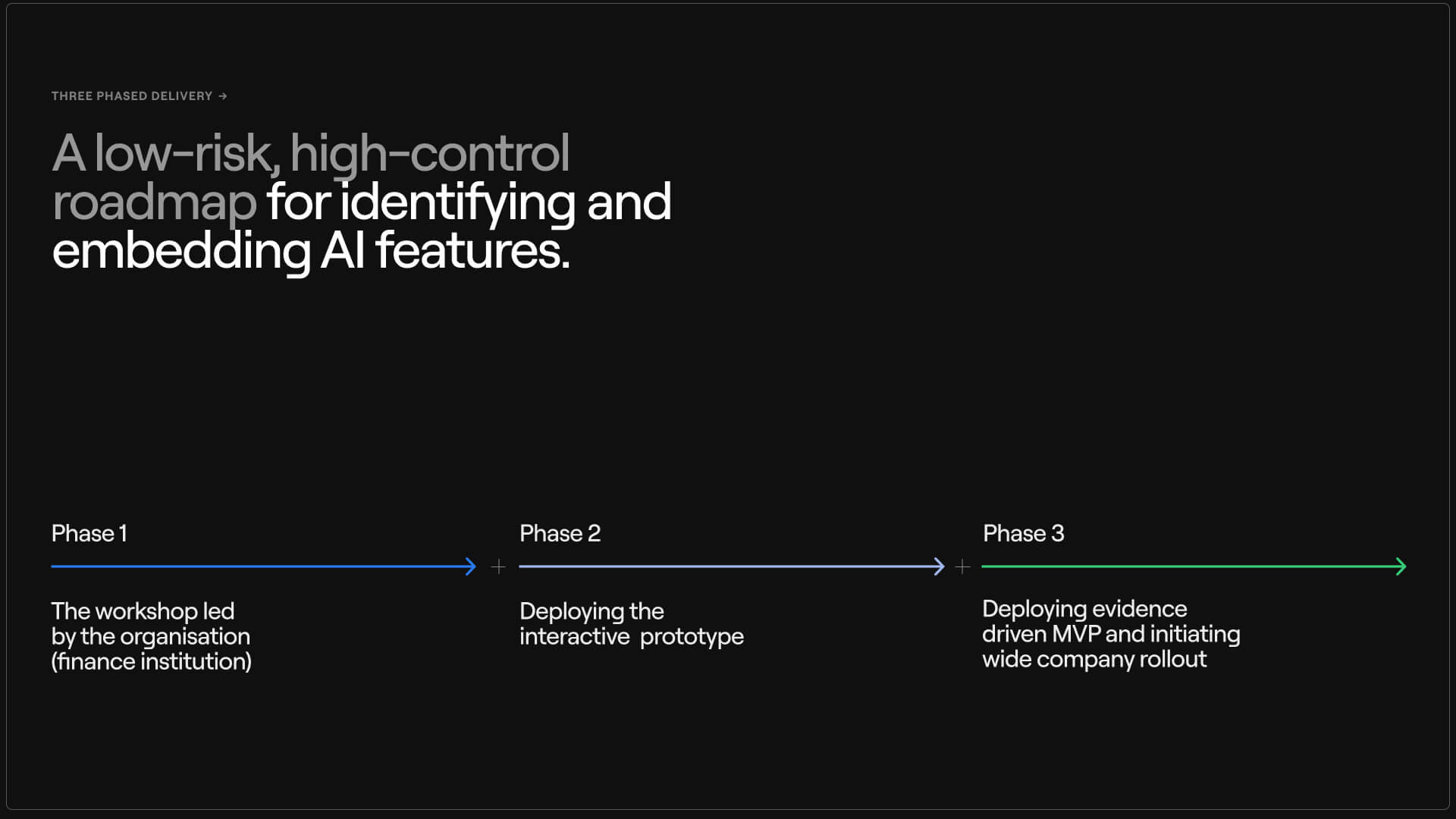
Phase 1: Spotting cases where AI could deliver measurable value in finance
What is the core objective of the workshop?
Phase 1 is the collaborative part of the discovery process that allows you to detect and narrow down cases where AI can deliver immediate value within your B2B products or workflows with minimal risk upfront.
At this point, we work together to create an evidence-based list of “candidate solutions” grounded in real problems from the field, without committing to specific technologies.
What do we deliver in Phase 1?
Strategic use case definition
We quickly help you generate a comprehensive list of potential AI use cases tailored to standard frameworks and products within your organisation. We then classify each case as High, Medium, or Low priority to provide a clear, evidence- based roadmap for custom AI feature development.
What is the outcome of Phase 1?
A prioritised AI ideas register, but with no technical or commercial lock in.
How do we structure Phase 1?
In order to move quickly enough to create momentum, there are 5 stages that that will take you from a wide open idea list to a ranked, defensible register.
Step 1: Context alignment
We start by getting everyone completely on the same page. Before anyone pitches a single idea, we align on your goals and confirm exactly what domains we are targeting so everyone shares the exact same expectations moving forward.
Step 2: Idea generation
We go through your domains one by one and capture every potential AI use case in a simple, plain sentence. There is no judging or prioritising here, the only goal is to get 30 to 50+ raw, unrestricted ideas on the board.
Step 3: Cleanup & clustering
Next, we tidy up the list. We remove any duplicates, clarify the wording, and group similar concepts together. To keep the momentum going, we strictly ban any debates about technology or feasibility at this stage. You will walk out of this step with a clean, manageable list of 25 to 40 refined ideas.
Step 4: The prioritisation filter
Now we actively filter the list. We run every idea through a shared, three-question judgment framework to objectively classify it as a High, Medium, or Low priority. The output here is your actual, prioritised AI register.
Step 5 Wrap-up & next steps
In the last step, we confirm the distribution of ideas and sanity-check the scope to ensure everyone is aligned. We take the single highest-priority use case agreed upon in the room and immediately transition it to our engineering team to begin the rapid prototype build.
How do we separate promising AI ideas from high-value opportunities?

Reasons to start with Phase 1 and identifying potential AI cases
You need to define the right technical approach for the specific use case
Define the potential ROI before moving forward with implementation
You don’t have a clarity on where to start with AI implementation
You are expecting hidden blockers (compliance, regulations, etc)
Phase 2: Fast deployment of the interactive prototype
What is the core objective of deploying the interactive prototype?
Phase 2 is directly connected to the previous phase and lets you see the highest-priority idea defined during the discovery workshop into an interactive prototype. It’s an AI-powered process where we build a clickable, functional interface that gives your stakeholders a tangible way to test the user experience and business logic before moving into a live pilot.
If you need specifics on how we deliver fast interactive prototypes with your data and how we structure the whole process in general, read this article: AI Prototyping for businesses: Moving faster to deliver a working prototype in one week
What do we deliver in Phase 2?
Interactive concept validation
We translate the selected high-priority use case into a working prototype. Your team will be able to interact with the actual workflow, and test how the AI feature behaves in realistic daily scenarios without needing complex code or live data integration upfront.
Rapid UX & logic refinement
We iterate on the prototype immediately based on direct feedback from your product, risk, and domain experts. This will ensure that the interface, data presentation, and operational flow match your exact standard frameworks before the live pilot phase begins.
Clear feasibility & scope blueprint
We map out the precise technical scope, minimum viable data sources, and security guardrails based on the validated prototype. This provides your IT, data, and risk teams with the exact visibility needed to approve data access and clear governance before we initiate the live pilot.
What is the outcome of Phase 2?
A fully interactive AI prototype and technical blueprint which will prove the concept works in practice before initiating a live pilot.
Phase 3: Deploying Evidence driven MVP and wide company rollout
What is the core objective of deploying the MVP and the wide company rollout?
After the successful validation of the ideas and confirming that they carry no risks, the Phase 3 naturally moves the solution from an interactive prototype into live daily operations.
This is where we build and deploy a production-grade MVP on real client data, run a controlled pilot with built-in manual fallbacks for operational safety.
Finally, after seeing how it behaves in a live environment, we use verified performance metrics to scale the feature seamlessly across the wider enterprise.
What do we deliver in Phase 3?
1. Secure data & logic integration
We connect the MVP logic to the minimum viable data sources required for the use case, so it can operate within your staging or live data environment. At the same time, we establish the access governance, data quality checks, and privacy guardrails needed to protect sensitive financial information.
2. Strict scope enforcement
We keep the live build focused on what we agreed during the workshop. We start with one ALM domain, one user role, and one core insight, which gives us a clear way to validate the solution without expanding the scope before we know what works.
3. Evidence-based roadmap update
We analyse user feedback to understand whether the solution should be scaled, improved further, or stopped. We then review the results with your leadership team and update the original High / Medium / Low priority register based on what we learned from real usage.
4. Evidence-led deployment decisions
We review what happened during the Phase 3 pilot together and use those results to decide which AI capabilities make sense to move forward with. The next steps are based on what we learned from the live environment, including whether the solution can work technically and whether it creates enough value to justify expanding it.
5. Strict sequencing & scope
We define the rollout path for introducing these capabilities into your wider product environment. Each step is planned around what the product can absorb at that stage, so the integration stays controlled and the team can expand the solution based on what has already been validated.
6. Workforce & operational readiness
Introducing AI across the organisation changes how teams complete their daily work, which means people need clear guidance on how to use these new capabilities. This is why we provide the operational guides and role-based workflows they need to understand where AI fits into their processes once the solution goes live.
7. Controlled integration
We expand the rollout across the selected business units and keep the process flexible as we move forward. If priorities change or new requirements appear, the scope and timeline can be adjusted without disrupting the wider implementation.
What is the outcome of Phase 3?
A validated MVP functioning securely in your environment, paired with clear, evidence-backed recommendations for scaling and validated AI capabilities permanently integrated into your core products and operations, delivering measurable business value without operational disruption.
9 clear benefits of this framework for financial institutions (banks and fintech companies)
1. Accelerates strategy without premature commitment
This framework allows organisations to explores high-potential AI capabilities without locking them into rigid technology stacks or fixed architectures before performance is proven.
2. Keeps organisations in complete control of the narrative
Organisations can define which business problems matter first, forcing AI providers to respond to a clear signal rather than steering the technology direction.
3. Generates a tangible and reusable assets
Organisations receive prioritised list of ideas which becomes a concrete asset that directly feeds MVP proposals, roadmap planning, and progress updates for
leadership.
4. Mitigates execution risk early
Making early "kill-or-defer" decisions prevents expensive pilots with low payoffs, ensuring MVPs are scoped tightly to proven areas of value.
5. Eliminates internal friction early
Brings product, risk, IT, and data teams into the conversation from day one, creating shared ownership and minimising late-stage governance objections.
6. Gives product strategy a clear path to implementation
Prevents initiatives from stalling by providing AI developers with crystal-clear guidance on exactly what to turn into actionable MVPs.
7. Solves problems inside real workflows
Every idea originates from the organisational workflows and decisions, filtering out generic "nice demos" that fail to solve material problems.
8. Satisfies strict regulatory and audit scrutiny
Gives internal risk committees and external regulators a documented, step-by-step audit trail. It sets clear boundaries on exactly where and how AI models operate inside the organisations or within the fintech products, proving compliance before going live.
9. Empowers confident go-to-market decisions
High-priority ideas can be immediately positioned as pilot offerings or sales differentiators, while low-priority ideas are visibly parked to reduce market ambiguity.
If you are just starting to identify where AI can add value across your financial organisation, make sure to explore our previous guides to see what realistic AI use cases look like in practice and what it takes to scale those capabilities over time.