
Forward Deployed Engineer: The Enterprise AI Delivery Model for Moving AI From Pilot to Production
Development
Reading time
4
mins


A practical guide that will help you understand the Forward Deployed Engineer (FDE) model and why applying it can help you turn your broad AI requests into AI solutions that fit your specific business context and reality, helping you create self-sustainable capabilities for the long haul.
A solution for solving ongoing enterprise AI implementation problems
Although the model itself isn't new, FDE is increasingly being discussed as a response to the growing pressure enterprises face from running a huge number of AI pilots that simply don't deliver results.
Executives and team leads usually start with broad, vague ideas of what the AI can do for the business, and the consequences are well known (in chronological order):
buying multiple generic AI tools
quickly starting multiple initiatives
reality check: AI tools break on outdated and incomplete company data
hidden costs appear with no returns on sight
abandoned pilots create deep disillusionment
leadership painfully forces a restart
Out of 88% of organisations actively using AI in at least one business function, only 6% qualify as "high performers" - (McKinsey survey on the state of AI).
The traditional approach in building solutions for the businesses has a hard time keeping up in translating and narrowing broad business demands into a solution that actually fits a specific manual workflow problem or a direct client request in the codebase.
So what does the Forward Deployed Engineering model give you that the traditional approach to AI implementation leaves out?
For starters, it builds solutions based on direct feedback gathered from your teams on the spot, by working around your teams and learning how they work, not from presentations.

Data source: Goodfirms Forward Deployed Engineering and IT Staff Augmentation Survey (surveyed among 133 AI and software companies).
What is a forward Deployed Engineer (FDE) model?
Forward Deployed Engineer (FDE) model is practice of placing a multidisciplinary team made of FDEs, AI engineers, designers and industry domain specialists inside a customer’s environment for an extended period to find a solution to a painful problem no one else in the organisation can solve or has the bandwidth to take on.
What does that exactly mean?
Unlike dedicated team projects that require lengthy onboarding, FDE engagement lets you move faster.
The common idea is that you embed the development team in your company to help you detect the problem and understand the starting position, all the way through the working system because you are committed to enabling the capability inside a complex real world environment.
How does it work with a Profico framework?
Step 1 - embedding our team into your business
Instead of relying on multiple presentations and theory, our team of experts (FDE Engineers, Designers, industry experts), is deployed directly into your teams.
There are 3 main reasons for that:
Understanding your daily processes (and your customer behaviour)
Understanding your systems
Using gathered knowledge to find leverage points we can build solutions around
The main goal here is to find the leverage, more precisely a place where ambiguity, exceptions and human judgement create the most drag.
Every company probably has hundreds of possible ideas where to place AI, and the FDE team is there to detect which delay occurs often enough to matter, which pain point is painful enough, and what is the potential fix which could release a bunch of work down the road.
Step 2 - scoping the work
Using the gathered knowledge we are able to translate initial broader context and vague claims into a first specific use case.
That is when we start to build the scope of work and steer it on the go to make sure we deliver what was promised in the given timeline.
Step 3 - building and shipping the solution
This is the process of technical delivery.
Forward Deployed Engineers build the solution directly within your environment against your infrastructure and constraints. Our FDE team then deploys the solution directly into the workflow identified in Step 1.
Building solutions doesn’t necessarily mean that everything has to build from ground up and redevelop your products and infrastructure. Sometimes a simple layer that sits above your system is enough to move the largest amount of work.
From there, we test and evaluate what we build to make sure that the built solution passed every test.
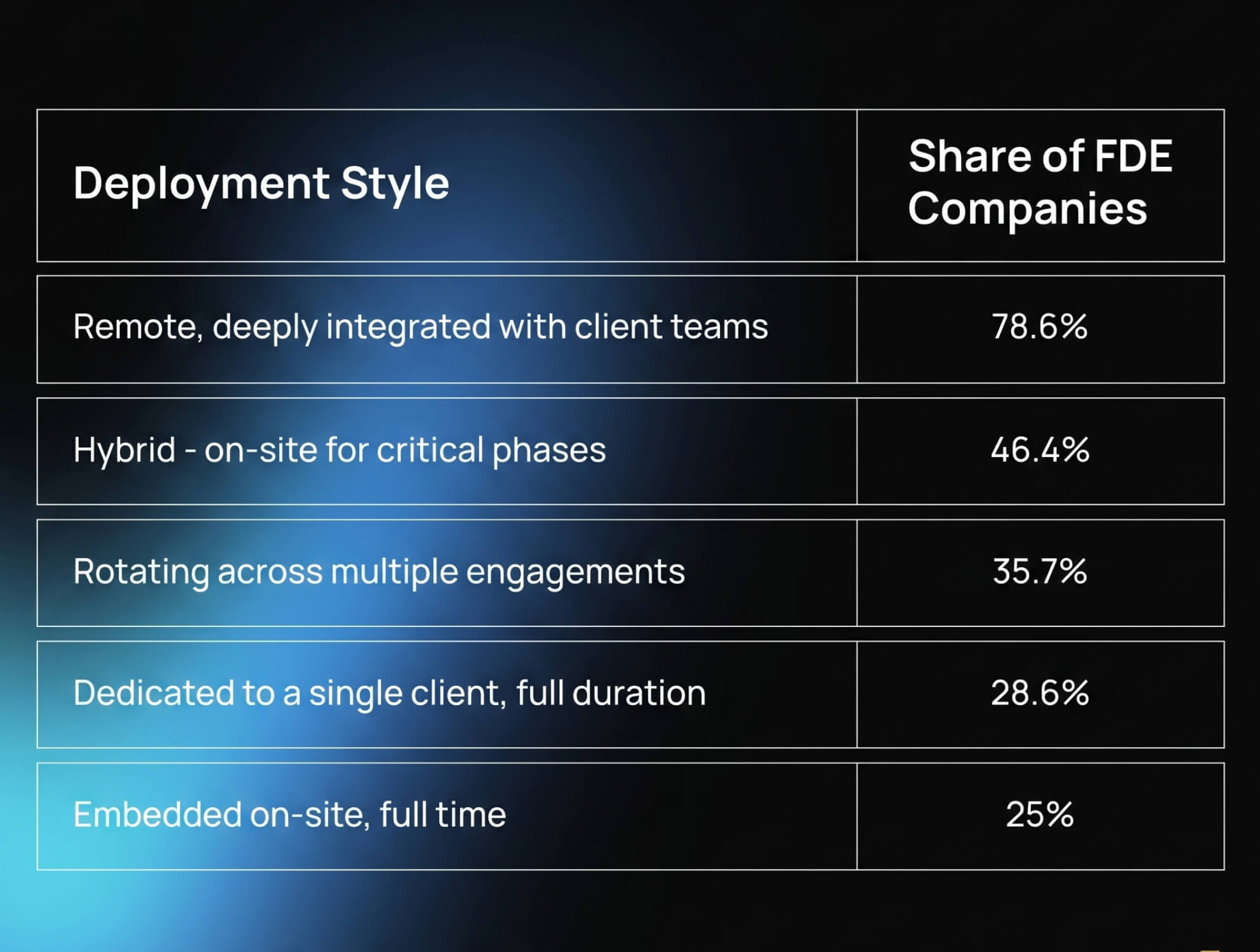
Data source: Goodfirms Forward Deployed Engineering and IT Staff Augmentation Survey
The purpose of Forward Deployed Engineering - example
For this illustrative example, let’s say that you run commercial lending operations at a bank.
Your CEO has by now seen enough presentations to know AI has the ability to read documents faster and now he tries to find a way to implement it in the bank.
And this is the part where the first problem appears. Executives believe that AI is plug and play process, but anyone who works at product or engineering already knows that the request doesn’t quite capture what is happening inside the workflow.
For example, a commercial loan might include a loan agreement, an underwriting memo, financial statements, collateral valuations, etc. So, before you can build anything you need to understand how all of that fits together in the work.
If you have a product manager responsible for the project and they just pass the request to the technical team and say: “speed up loan reviews with AI”, the team will have to take most of the product decisions for him/her.
A great product manager would do research and check for the loan files that took longer to be reviewed.
One of their conclusions might be that the reason why it takes longer to process longer files is that the information is spread across several documents. Reviewers needed to find relevant causes, cross-checking documents, etc, and put the answer in the reporting.
As a second problem, a product manager finds out that some loans have complicated structures and some require judgement, while some decisions have regulatory consequences, so you can’t just hand them over to AI.
As the third problem, let’s say that the bank reviews 2,000 loan files a month and 600 are “complicated” and incomplete, and each of those takes two days to review, that is already 1,200 days of review time every month spent working through those files.
So what is the role of the FDE here?
The FDE works alongside the lending team and gets into the process of learning more about loan operation process with them.
They learn which documents the team looks at, which information matters, and how people decide which source to trust when the same information appears in several places.
Instead of building an AI system that generally “reads loan documents,” the FDE builds around the specific review work that happens again and again.
The same engineering effort can either get spread across hundreds of plausible places to add AI or go into one part of the workflow that happens hundreds of times and holds up everything behind it.
How will you know that your business needs a Forward Deployment Engineer?
1. Failing to get AI pilot into the production
A company might have a pilot that looks successful in isolation, yet once you bring it into the working environment, it may not fit the way people work or the systems already in place.
Recent studies shows that getting through the last mile of AI transformation remains one of the biggest challenges for businesses.
The benefit of the FDE is that they are not there just to consult you about the possible solutions, they help businesses get to the bottom of the problem, build and inspect the system and stay around after the launch long enough to learn whether people actually use it and whether the results are worth the cost.
2. Inability to define a business problem
Sometimes the teams already know that there are clear problems that slow down the workflow, but when you have different stakeholders that see the problem from different angles it can be difficult to fully articulate it.
If you bring FDE into the picture, you bring the ability to build products and solutions together with industry expertise. Working alongside the business team, the FDE can help turn a broad problem into something specific enough to build against.
3. You have the use case, but not the tech or team to build it
Sometimes, an organisation knows exactly what it wants to build, but it faces three technical capability problems:
not enough people capacity to take another complex project like AI enablement
not having the technical skills
lack of processes and infrastructure
This is the part where FDE's depth comes into the play because embedding them into the organisations will give you a way to purse AI opportunities without having to lose time on hiring new team or building all of that capability internally.