
AI Prototyping for businesses: Moving faster to deliver a working prototype in one week
Development
Reading time
5
mins
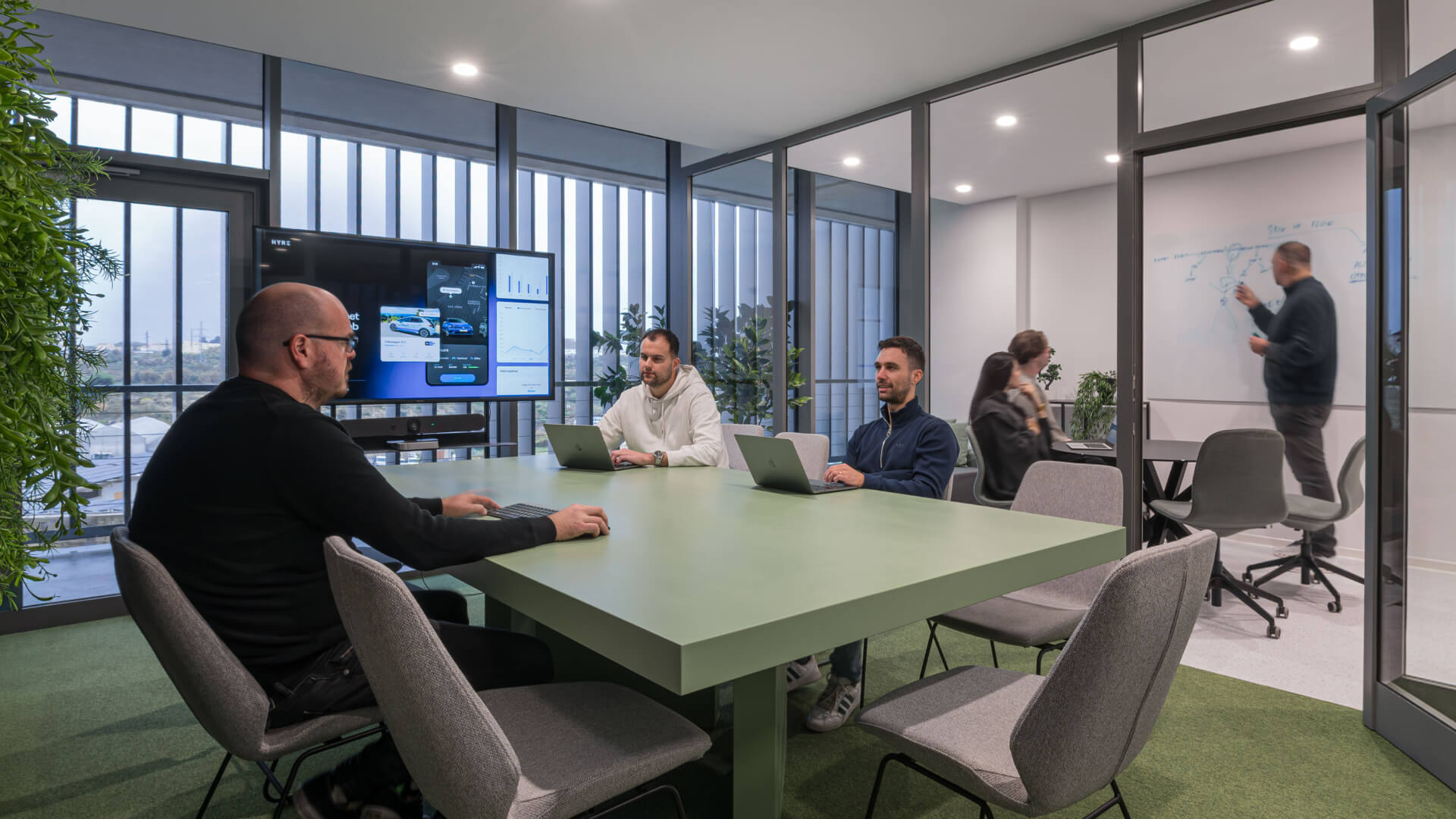

"One week of an AI-powered workshop will help us replace weeks of work.”
That was our product team's main takeaway after we handed a client a working prototype in exactly one week.
Normally, you spend a few weeks passing static wireframes back and forth just to make sure everyone is on the same page.
This time, the client interacted with a functional prototype we developed in 72 hours, which gave them a clear understanding of the direction and enabled us to receive immediate feedback.
Watching them react to a tangible build made it clear that AI is changing the standard development cycle and, more importantly, it shifted our perspective.
We realised AI gave us the ability to restructure the entire product development cycle, allowing teams to turn raw business requirements directly into a functional environment that stakeholders can test from day one.
In this article we’ll give you a closer look at how our AI-powered workshop works, and why it makes getting a project off the ground a lot simpler.
Lowering MVP risk and development time with AI
Getting a product to market faster is likely your business top priority right now, yet pulling it off smoothly is rarely as simple as it sounds.
Nailing that launch depends heavily on an intricate balance of maintaining a clear direction while managing the daily realities of the build process.
Of course, the team bringing this to life needs to capture your exact vision and delight the end user without sacrificing the quality of the final outcome.
Now that AI has entered the game, there is a very real opportunity to shorten that cycle and get a clickable model in front of your customers remarkably fast, bringing your product to life much sooner.
The accelerated process of AI prototyping also unlocks a deeper advantage that used to be slightly more cumbersome to manage with standard methods a couple of years ago. Having a working draft early on naturally creates space to evaluate the main risks tied to launching anything new.
Market Desirability (Validating Customer Demand): We need to figure out if your target audience truly needs this solution to prove there is real demand before running through the budget.
Technical Feasibility (Development Constraints): The team needs to determine if the structural foundation can support the idea within your given timeframe and spot any physical boundaries early in the process.
Business Viability (MVP ROI and Monetization): The concept needs to make financial sense by aligning with your chosen business model and long-term profitability goals.
Product Usability (UX/UI and User Experience): The layout relies on intuitive interface design and early user testing to ensure the workflow feels natural rather than frustrating.
Approaching your product journey with AI offers a practical method to reduce these hurdles and adapt comfortably as your idea evolves.
How an AI-Powered discovery workshop prioritises building over planning
Spending weeks on discovery sessions and static wireframes just to build consensus feels impossible to justify when the AI tools now exist to capture and structure that same information instantly.
Knowing that businesses naturally expect this new level of speed without compromising their vision, we bypassed the usual manual workflow and integrated AI directly into the initial discovery phase.
In the discovery phase, where we learn everything from the business, trying to understand their idea, their users, etc, we use AI tools to record and transcribe every stakeholder requirement in real time.
Instead of going back and forth over email with the client, we feed those live transcripts straight into tools like Claude to establish a precise set of guidelines.
It is a great way to cut down the timeline, especially since this raw information helps us generate a comprehensive PRD that actually reflects the data architecture discussed in the room.
We walked away with a blueprint that was more accurate than a traditional three-week scoping phase.
All that was left was the actual build, which became our sole focus over the next few hours.
Delivering a functional AI prototype: From concept to live data in 72 hours
Having a precise PRD gives the dev team a clear roadmap and ensures everyone is aligned on the technical requirements.
But a document can't capture all the complexities that emerge when a product interacts with real-world systems and data.
We needed to see the underlying architecture in motion to understand exactly how our backend logic handled the friction of the client’s data imports.
We used Claude Code to ingest our Figma assets and wire up the working environment.
This gave us a functional AI prototype where the client could interact with their own business data immediately, exposing expensive data relationship flaws before they ever reached the production roadmap.
The patterns we kept seeing with AI prototyping
1. Better exploration of ideas before PRD
One of the clearest takeaways for us was simply having the space to map out multiple ideas immediately.
Running through different product directions usually takes a lot of coordination and time, but now, that barrier is basically gone. We get to look at a broad set of possibilities upfront, well before any designs or specifications are locked in.
To give you an idea, our lead product designer was pulling up entirely different concepts for the exact same problem in a matter of minutes.
It is a really smooth way to work, mostly because the main benefit isn't just the speed.
Now we get to test our actual assumptions before the PRD is finished, and before any architecture decisions are set in stone.
2. Faster alignment with the team and the business
Getting product, design, and engineering aligned happens much faster when everyone is simply clicking through the same working model.
It is a great way to maintain momentum, especially since the live model allows us to iterate on the design in real-time during those calls rather than scheduling follow-up reviews.
We still write formal requirement documents to define the business metrics, but the prototype now serves as our actual reference implementation.
We just walk away needing to document a working system the entire team has already experienced and verified together.
Why a functional AI prototype is the best way to protect the development budget
The initial estimate for this project sat at 6,000 hours of development work.
Rolling out a functional AI prototype like this doesn't replace that entire timeline, but it acts as a high-stakes filter for every hour of engineering that follows.
It surfaces technical flaws before the main budget is even allocated, replacing weeks of hypothetical planning with a working system that handles real business data.
And it ensures the production roadmap is based on how the architecture actually performs under a real load.
This approach delivers three specific outcomes that a static document cannot replicate:
Spotting the deal-breakers early. Finding a sync error on Day 3 is a minor pivot. Finding it after 1,500 hours of engineering could be a blow on the budget. This prototype proved the data logic worked before the first "official" sprint even started.
Ending the departmental "telephone game." It’s hard for Finance, IT, and Sales to argue over a feature when they can log in and see the logic in motion. This cuts out the weeks of back-and-forth emails that usually stall momentum and inflate costs.
Cutting the fat from the roadmap. Interacting with live data revealed that several "must-have" features from the original plan were actually redundant. We were able to trim the final production scope by 20%, focusing the remaining hours only on the functionality.
Because this discovery happens before the main engineering team is fully spun up, the project stays lean while building on a foundation that has already survived contact with real business requirements.
How a live AI prototype speeds up your go-to-market timeline
Putting a live prototype into the hands of real users establishes an immediate feedback loop that pulls your launch strategy forward by months.
Watching actual customers navigate the prototype lets you identify critical UX/UI bottlenecks and validate core use cases long before the final code is written.
That eliminates the traditional "dark period" of software development, turning a passive waiting phase into an active engine for market validation.
What can your team actually do with the prototype while engineering builds the final product?
Secure Pre-Launch Revenue. A functional shell gives your sales team a live environment for prospect demos rather than a static slide deck. This allows them to secure early contracts while the main engineering team is still building the permanent back-end.
Capture Behavioral Data. Product managers can watch real users navigate the interface the moment the initial sprint finishes. This highlights actual workflow friction, ensuring expensive production hours aren't wasted building a feature nobody will ever use.
Accelerate User Acceptance. Internal operations teams use the live UI to begin employee training immediately. This prevents the workflow shock that usually happens when a company drops complex new software on its staff all at once.
Capturing Behavioral Data. The moment the initial sprint finishes, product managers can watch real users navigate the interface. This highlights actual workflow friction, ensuring you don't waste expensive production hours coding a feature nobody wants to click.
Accelerating User Acceptance. Internal operations teams use the live UI to begin employee training immediately. This prevents the workflow shock that usually happens when a company drops complex new software on its staff all at once.
How Our AI product discovery workshop turns raw business ideas into a live prototype
Our AI Product Discovery workshop is designed to force your raw business concept to behave like a real product immediately.
You bring the core logic and whatever data structures you have in mind.
We use rapid AI frameworks to ingest those parameters and wire up the foundational data routes directly into a working shell.
This gives your business an immediate proof of concept to test your market assumptions, and hands your engineering team a validated baseline before the heavy coding actually begins.
FAQ: What this actually requires from your team, your data, and your tech stack
Does building an AI prototype lock my engineering team into a specific tech stack?
No. The prototype is built for speed and logic validation, usually leveraging rapid frameworks. Once the data routing and UX are validated, your production team can build the final, scalable product in whatever stack fits your enterprise infrastructure. The prototype is a functional blueprint, not a software prison.
What happens to our proprietary data during the AI build process?
We use sanitized, dummy datasets that mirror your database schema without exposing sensitive information. The goal of the prototype is to prove that the structural pathways work. We aren't feeding your actual customer records into public LLMs.
How much time do you actually need from my internal team?
Very little. We need a single, focused kickoff to isolate your highest-risk data connections and define the core user flows. After that, we go dark and build. You aren't paying us to sit in endless daily standups; you are paying us to deliver a working prototype.
What do we actually need to bring to the kickoff?
Bring the core logic and whatever data structures you have in mind. A standard spreadsheet, a rough sketch of the customer journey, or a solid list of business rules is enough. We take those raw parameters and wire the foundational data routes directly into a working shell. If you can explain the daily mechanics of what the product needs to achieve, we have exactly what we need to start building.